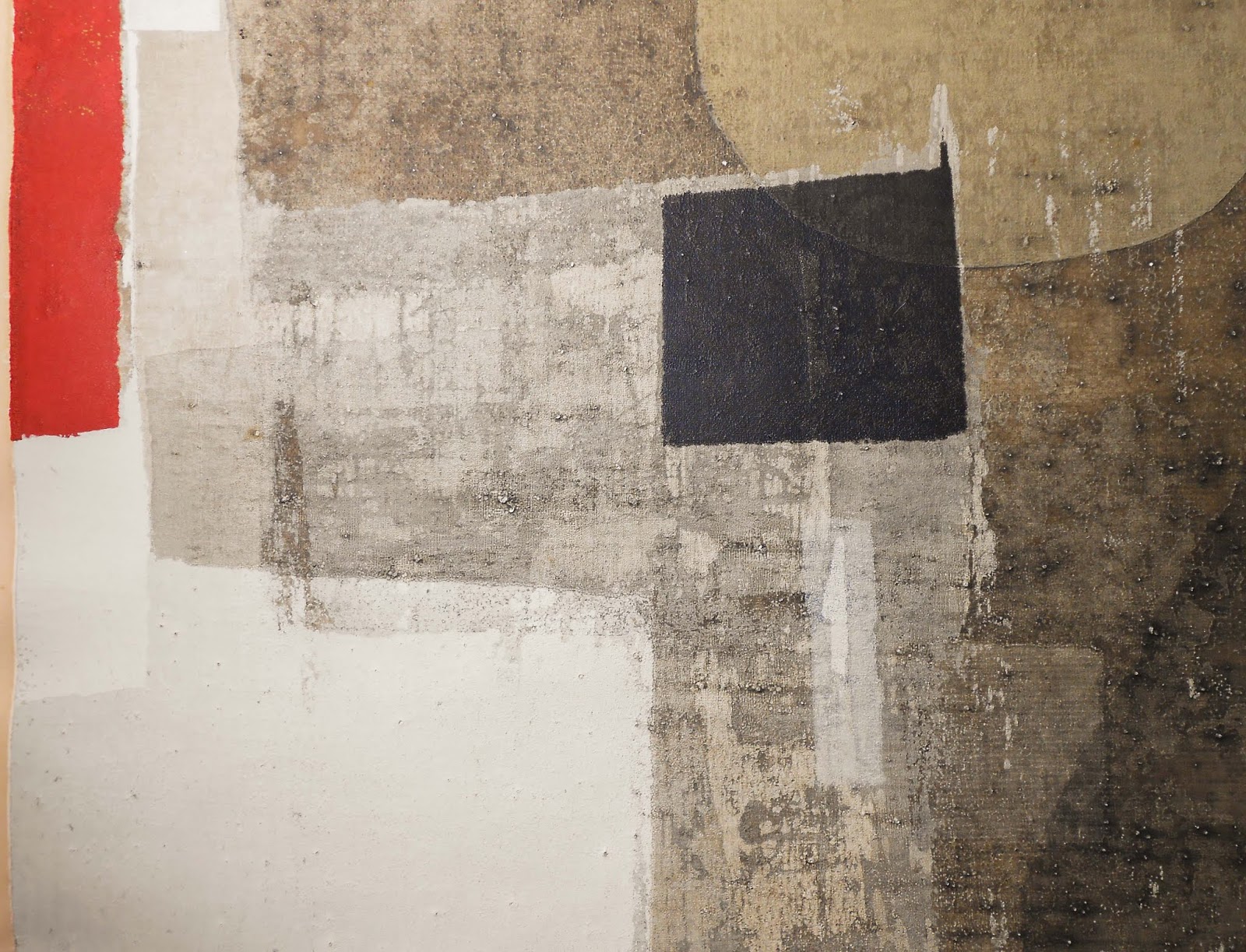
RARE NORIO AZUMA (JAPAN/USA, 1928-2004) MID-20TH CENTURY VINTAGE MODERNIST PENCIL SIGNED ARTIST PROOF, TITLED 'THE ORB OF DAY,' GEO-ABSTRACT COLOR SERIGRAPH ON FINE FABRIC, AFFIXED TO BOARD
[Image was laid down on board by the artist & not afterwards by the picture framer]
Circa 1958-1966
Mid-20th century Japanese vintage Modernist printmaking & color serigraph art prints
DIMENSIONS:
Frame: 23 3⁄4" Width x 19 3⁄4" Height x 1 1⁄2" Thick frame
Image: 18 1⁄2" Width x 14 1⁄2" Height
DESCRIPTION:
This rare artist proof authentic and original Norio Azuma (Japan 1928-2004) color serigraph art print on fabric (fine linen canvas) laid down on paper is a unique image, with the edition of the work titled 'The Orb Of Day,' possibly not being subsequently realized by the artist, making this artist proof of the image a unique, one-of-a-kind, color serigraph print, with no other image edition exactly like it. It remains in its original, period Modernist frame presentation, with its original, off-white mat board and thin-profile, polished chrome Modernist frame. The backing corrugated board used at the time of this initial framing, looks to have been exposed to moisture at some point in time, possibly occurring during storage of the work. The image has been taken out of its frame for professional cleaning and for close examination. The color serigraph isn't damaged but the paper it's laid down upon along the left margin is slightly waved, which can be only closely seen under the left margins of the off white mat board. It is barely noticeable and is not distracting or a depreciating condition issue. The pictorial plane of the actual color serigraph print, nor the top mat board are affected. The old glass was swapped out and exchanged with new picture glass to improve the visibility of the artwork. The color serigraph print is clearly signed along the bottom margin 'Artist Proof.' The heavy color serigraph inks, which are painterly, viscous and which give the work its physicality and plasticity, are slightly crackled or crazed in places on the print. Again, this condition is commensurate with the print being a vintage work of art and now being nearly 55-60 years old. Absolutely gorgeous and quite possibly a one-of-a-kind image produced by the indomitable and indefatigable Japanese-American master Modernist printmaker Norio Azuma.
PRINTMAKING TECHNIQUE:
The signature style that Japanese-American Modernist artist and master printmaker Norio Azuma developed over time, is at once recognizable and familiar to those who have been previously exposed to Norio Azuma's very particular form of Modernist, geo-abstract fine art printmaking. His time-consuming and very specific individual technique involves using several different silkscreens to create the multiple layers of both opaque and semi-transparent colored inks and layered graphic iconography found in his works. This is not an ordinary, pedestrian color serigraph but a highly developed, individual printmaking style that has made Japanese born Modernist printmaker Norio Azuma famous the world over. Norio Azuma used a visually poetic geo-abstract graphic iconography with soft edged geometric shapes, consisting of mostly squares and rectangles, often with diffused edges and forms that slid over and under each other, creating what looked often like a graphic schematic grid or complex molecular atomic models. What makes Norio Azuma's period Modernist vintage color serigraphs unlike other silkscreen fine art prints, is his use of fine linen or finely woven canvas as a printing surface, rather than artist paper, as was used by most other printmakers. Azuma would print on the canvas and after several passes with different silk screens, often numbering up to two dozen individual passes, before he achieved the desired effect. In conclusion, Norio Azuma individually raised the art of Modernist printmaking and the serigraph form to a higher level after his lifetime of experimentation and his insistence the fine art print as being on the same level of importance and relevancy as oil paintings on canvas, which had always occupied the apex of fine art production for centuries. Azuma seemed to achieve what virtually no other Modernist printmaker had achieved up to that point and that was to create highly plastic, seemingly hand-to-surface works of art on paper, with textured, layered surfaces, populated with viscous ink and often aggregate or other applied material, used to emphasize the physical, tactile surface of the printed canvas. For Norio Azuma, silkscreen ink was oil paint and his coveted and internationally renowned vintage Modernist color serigraphs on fabric, certainly look more like the early Modernist Cubist oil paintings of Pablo Picasso and Georges Braque than they do the super flat, Pop-Art color serigraphs that had come to define Modernist printmaking and the serigraph form in particular. Norio Azuma's work is in stark contrast to other Modernist practitioners of silkscreen prints, such as the American artist and printmaker Andy Warhol and a host of others, who used and celebrated flat, almost always opaque silkscreen inks, to lend an entirely contemporary, highly graphic and 'clean' appearance to their works. Norio Azuma's color serigraphs on the other hand, were 'dirtier' and from the Earth, resembling Modernist geo-abstract oil painting, with his use of painterly layering and which resembled the glaze technique found in period oil painting, created with thin oil painting medium mixed with oil paint. Azuma's use of nearly transparent, semi-transparent and opaque silkscreen inks and his use of layering that permitted and allowed for a 'dirtier,' more worked and more highly manipulated surface, clearly defined his works and separated them from other Modernist practitioners of the form and of his time.
PICTURE FRAMER/PREPARER:
With original picture framer's paper label from 'Blondelle Frames, New York,' affixed to the back of the print.
BIOGRAPHICAL INFORMATION:
Norio Azuma was born in 1928 and studied art while a youth in his native Japan. After emigrating at some point (it's unknown exactly when) to the United States, Azuma then continued his art studies at the Chouinard Art Institute in Los Angeles, CA and then at the Art Student's League in New York City. Azuma worked as a printmaker, experimenting with creating serigraphs on canvas rather than paper, then a relatively new development for Modernist practitioners of the craft and in the evolution of printmaking. At one point in time, the New York Times art critic, John Canaday, in an art review of an exhibition where Norio Azuma's painterly color silkscreen fine art prints were on display, once described one of Azuma's serigraph prints as "so beautiful a manipulation of shape, color and texture, that it eliminates my lingering objections to serigraphy as a technique." Azuma exhibited internationally, including: '30 Contemporary American Artists, USIA; 28th Corcoran Biennial Exhibition, Washington, DC; the 3rd International Triennial of Original Graphics; Contemporary American Artists at The White House; Sculpture and Prints at the Whitney Museum of American Art; the Kagai Sakka Ten at the Tokyo Modern Museum of Art and American Art Today at the New York World's Fair. His work can also be found in numerous collections, including: Whitney Museum of Art, University of Nebraska, Brooklyn Museum of Art, Butler Institute of American Art, Seattle Art Museum, Pennsylvania Academy of Fine Art, Cleveland Museum of Art, State University of Potsdam, Smithsonian Institute, The Free Library of Philadelphia, Library of Congress and Chase Manhattan, to name a few.
CONDITION:
Good to Very Good overall vintage condition.
◊※◊⋉✧⋊◊※◊⋉✧⋊◊※◊⋉✧⋊◊※◊⋉✧⋊◊※◊⋉✧⋊◊