Saturday, November 6, 2021

SCARCE GUSTAVE VIDAL (FRANCE, 1895-1966) EARLY 20TH CENTURY VINTAGE 
SIGNED ORIGINAL POST-IMPRESSIONIST OIL on CANVAS 
LANDSCAPE of FRENCH SOUTHERN 
COUNTRYSIDE with MOTHER & CHILD, CYPRESS 
CEDAR TREES, RED TILE ROOFED, 
PROVINCIAL HOUSES, DIRT ROAD & DISTANT 
MOUNTAINS, in ORIGINAL PERIOD WOODEN 
CHIP-CARVED, GESSOED FRAME
[Featuring viscous, tactile, heavy impasto paint applied with both palette knife and artist's brushes] 
(Circa 1920-1935)
Early 20th century, pre-WWII French Post-Impressionist, heavy, impasto landscape oil paintings on canvas depicting French rural life and French provincial landscapes

⟣⏣⦂⎔⦂⏣⟢○ꊞ○ꊞ○ꊞ○ꊞ○ꊞ○ꊞ○ꊞ○ꊞ○⟣⏣⦂⎔⦂⏣⟢
DIMENSIONS: 
Frame: 23 3⁄4" Height x 27 1⁄2" Width 
Image: 17 1⁄2" Height x 21" Width
Weight: 12 lbs. 8 oz. 
 
DESCRIPTION:
Offered for your review and consideration is this estate fresh and only recently discovered in a well-appointed North Shore, Massachusetts home, early 20th century French Post-Impressionist oil on canvas by the well-listed French painter Gustave Vidal. The painting was literally covered with layers of dust on its verso, which has since been carefully removed. The work is clearly signed by the artist in paint 'Gustave Vidal' in the lower right corner of the pictorial field. The oil paint is heavily applied and has an impasto, highly tactile and viscous quality, being applied with both palette knives and brushes. The scene is a favorite one of Vidal, being a provincial, rural, bucolic and eerily quiet view of the south of France near the rise of the French Alps, which can be seen on the horizon. A woman can be seen walking down a dirt road holding the hand of a young child with clusters of draught resistant cypress and cedar trees to the right, next to a red tiled country home, with another stucco sided and red tiled roof villa in the distance. Gustave Vidal and other early, as well as late French Post-Impressionist painters favored the south of France, not because of earlier visits by the Dutch painter Vincent Van Gogh but because the south of France, the rural, provincial portion, far away from the sprawling urban metropolis of Paris, never really seemed to have changed very much and still looked as if it was locked in time or at least with a 19th century appearance. With warm, glowing sunlight and dry, arid conditions in which to realize these 'en pelin aire' landscape paintings out-of-doors, the south of France readily lent itself to these French Post-Impressionist painters, such as Gustave Vidal, who wanted to capture this veritable 'time-capsule' and to forever preserved the way slowed down, simple French provincial life at least used to be, without dirt roads becoming paved with asphalt and automobiles traversing around everywhere, replacing omnipresent pedestrians and horse and carriages. This pre-WWII oil on canvas is a scene often painted by Gustave Vidal, with its formal composition and figurative elements of rural buildings, trees that favored the southern Mediterranean climate and French rural fold or farmers and their families, going about their business as if unnoticed. This intimate portrait of their now vanishing lives, is frozen in place and captured in paint for all to see. Tremendous physicality, plasticity and terrific handling of the paint, as if wrestled with on the canvas, recalls the surfaces of another Dutch Post-Impressionist landscape painter, none other than Vincent Van Gogh, who also favored this physical style of painting, with his own heavy, impasto surfaces. Van Gogh is said to have painted largely standing up, putting the entire force of his body into the work. I think the same can be said of Gustave Vidal. The painting's surfaces are undamaged and there's no crazing, crackling, paint loss or repairs to the canvas, old or new. There's also no 'in-painting' old or new. This is an absolutely untouched and estate fresh work of art and signed period oil on canvas that certainly could be professionally cleaned by trained, capable hands, in order not to 'skin' it but to only remove the now fatigued original Damar varnish layer still covering the painting. We've elected to leave the oil painting as we found it and as it was discovered in the home, where it is said to have been for as long as anyone associated with the generational estate, could remember. Exhilarating. Very fine. Absolutely untouched. Simply breathtaking.
 
CONDITION:
Very Good to Excellent overall antique condition.


≪≒≓≫❖≪≒≓≫❖≪≒≓≫❖≪≒≓≫≪≒≓≫❖≪≒≓≫


Wednesday, November 3, 2021

VERY RARE 1808, THOMAS CLARKSON, 'The ABOLITION of the AFRICAN SLAVE-TRADE,' VOLUME 2, TRUE 1st ENGLISH EDITION, LEATHER-BOUND, with RARE, INTACT, ILLUSTRATED FOLDED WOODBLOCK PRINT PULL-OUT on HEAVY COTTON RAG PAPER, featuring PRESSED HARDBOARD COVER & STAMPED, EMBOSSED GOLD, GILT TYPOGRAPHY on VOLUME'S LEATHER SPINE
[Leather spine is still intact but with a loose front cover, while the folded, pull-out woodblock illustration has no loss, rips or tears, with only minimal foxing & remains nearly undiminished on heavy white cotton rag paper]
(Dated 1808)
Early 19th century English abolitionist literature and illustrated volumes depicting the illicit African slave trade and the trafficking of human beings from the African continent to the Americas against their will

⟣⏣⦂⎔⦂⏣⟢○ꊞ○ꊞ○ꊞ○ꊞ○ꊞ○ꊞ○ꊞ○ꊞ○⟣⏣⦂⎔⦂⏣⟢

'The History of the
Rise, Progress and Accomplishment
of THE ABOLITION of
the AFRICAN SLAVE-TRADE by THE BRITISH PARLIAMENT by THOMAS CLARKSON, M.A. in TWO VOLUMES.'
VOL. II. London:
Printed by R. Taylor and Co., Shoe-Lane,
for Longman, Hurst, Rees, and Orme,
Paternoster-Row.
1808.
Printed by Richard Taylor & Co. Shoe Lane
DIMENSIONS: 
8" Height x 5" Width x 1⁄2" Depth
 Weight: 1 lb. 10 oz.
INFORMATION ABOUT THE AUTHOR:
Thomas Clarkson (England, 1760-1846) was an active English proponent of the abolition of slavery and one of the United Kingdom's leading protagonists and vocal campaigners against the slave trade and trafficking of human beings in the vast British Empire, where British slave traders were often the entrepreneurial agents and malevolent actors, in this illicit kidnapping and transport by sea, of human beings from the African continent to the New World of the Americas, where the human 'cargo' would then be sold to the highest bidder, for a life of uncompensated servitude, toil and inhumane bondage, becoming the property of another human being, who purchased them on the open market, much as they would do livestock. Thomas Clarkson helped found The Society for Effecting the Abolition of the Slave Trade and assisted with the passing of the Slave Trade Act of 1807, which essentially legally and legislatively terminated the long British involvement in the trading of African slaves. Clarkson, in his later years, would go on to campaign, much to the chagrin of the Dutch and others still involved in this illicit trade, for the complete and total abolition of the slave trade worldwide, which of course was resisted by quite powerful forces, who had made up until then, exponential amounts of money off of human trafficking. The ongoing thrust of his abolitionist efforts were directed away from England and toward ensuring the enforcement of the legislative act and continuing his crusade in the rest of Europe. 
DESCRIPTION:
The volume's author Thomas Clarkson first published this 1st English leather bound edition, with the now infamous black and white woodblock print, folded pull-out on heavy white cotton rag paper. The later, subsequently published American edition, following the introduction of the English one, didn't have the same large folio pull-out woodblock print, depicting African slaves stacked like cordwood on various decks of the wooden ships, with literally no room to move, packed like boxes of merchandise on wooden planks for their long trans-Atlantic journey as European captives. This is a very rare, early 19th century English first edition from 1808, with its original leather and hard cover jacket, with embossed gold gilt typography on its leather spine. It is now 213 years old. Extraordinary and an important early 19th century abolitionist artifact and early piece of abolitionist, anti-slavery English literature, that proceeded to have convulsive, cataclysmic effects on the course of history in the Americas and elsewhere in the imperial European colonies. A must-have volume for any serious antiquarian book collector, social activist, educational institution or public library with a rare book collection. Very rare. Untouched.
INSCRIPTION(S): 
With previous owner's name on paper attached to first page, 'F. H. Mullen, M.D.'
(With 592 complete pages.)
CONDITION:
Good to Very Good overall antique condition. 
ADVISORY:
Please carefully read the description and carefully review the photographs presented in the listing to get an accurate condition description. This rare antiquarian volume is untouched and appears to have had no previous or contemporary repairs. It is being sold as it was discovered in the estate, south of Boston, Massachusetts, where it was found in the library of the home.
(*Please scroll down the page to view enlarged photos below. Thank you.)


≪≒≓≫❖≪≒≓≫❖≪≒≓≫❖≪≒≓≫≪≒≓≫❖≪≒≓≫


---------------------------------------------------------------------------- ≪≒≓≫❖≪≒≓≫❖≪≒≓≫❖≪≒≓≫≪≒≓≫❖≪≒≓≫❖≪≒≓≫

Monday, November 1, 2021

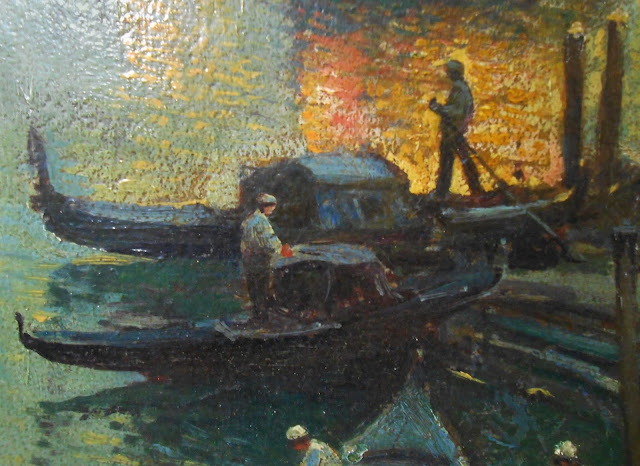
 ARTHUR VIDAL DIEHL (UNITED KINGDOM/UNITED STATES, 1870-1929) 100% ABSOLUTELY UNTOUCHED & UNALTERED, ESTATE FRESH & NEW to the MARKETPLACE, SIGNED OIL on ARTIST BOARD, VENETIAN SCENE, featuring THE ADRIATIC SEA, VENETIAN DOCKS, ILLUMINATED, LATE AFTERNOON, SUN BATHED VENETIAN ARCHITECTURE, MULTIPLE FIGURES ATTENDING VARIOUS GONDOLAS & LARGER MASTED SAILING VESSELS, SIGNED ARTHUR V. DIEHL in LOWER RIGHT on PICTORIAL FIELD, in 1940'S/50'S PERIOD 
GESSOED WOOD FRAME 
[Found in a well-appointed southern New Hampshire fine estate]
(Circa 1895-1915)
Late 19th to early 20th century American Post-Impressionist seascape & landscape painting of European, North African & exotic foreign sites 

≪≒⸎≓≫❖≪≒⸎≓≫❖≪≒⸎≓≫❖≪≒⸎≓≫❖≪≒⸎≓≫❖≪≒⸎≓≫❖≪≒⸎≓≫
DIMENSIONS:
Frame: 14" Width x 22" Height
Painting: 9 ½" Width x 17 ½" Height
Weight: 2 lbs. 2 oz.

DESCRIPTION:
Offered for your review and consideration is this, just recently discovered in a finely appointed southern New Hampshire estate, fresh, absolutely untouched and uncleaned, original, authentic, late-afternoon, sunbathed Venetian harbor scene, done by the well-listed and well-collected British-American, Post-Impressionist painter, Arthur Vidal Diehl, who came from London, England and eventually settled in the artist colony of Provincetown, Massachusetts, electing to paint under the famous 'platinum skies,' many 'en plein aire' painters favored and coveted, which made artist colonies such as Provincetown, Rockport, MA and Ogunquit, Maine, so popular among painters. Here the academically well-trained painter Arthur Diehl trains his attention on a late afternoon, sun-drenched Venetian harbor, with the skirt of the Adriatic Sea (an extension northwards of the larger Mediterranean Sea) meeting the sunlight illuminated, neo-classical, Italianate towering architecture rising in the background. Large, masted sailing vessels appear moored in the harbor, while several figures attend to wooden gondolas, tied to wooden docks. The scene is sensitively painted with sharply angled, late afternoon sunlight, bathing the architectural horizon above the water with the reds, oranges and yellows of warm light, while Diehl quite capably and seemingly effortlessly, captures the cooler, now cast in shadow, foreground of water, with deep ultramarine and pthalo blues. Figures working the various returning or departing gondolas are also cast in this cooler, darker light in the foreground as well. There are several opposing elements operating in the painting, which act as formal plastic devices Arthur Diehl consciously incorporated and wielded, in order to create divergent pictorial temperatures, image depth of field and points of focus. This is clearly a masterwork by the much celebrated turn of the century British-born and American Post-Impressionist painter Arthur Vidal Diehl. The oil painting hasn't been cleaned and of course, could use professional cleaning and re-varnishing with fresh Damar varnish. We've elected to leave it alone and as we purchased it directly from the estate where it was taken from, after being in that same house for nearly as long as the descendants of the original owners, could remember. There are a few superficial surface scuffs to the old varnish occurring in the atmosphere and a very slight, nearly unnoticeable small abrasion in the artist board found near the center right margin of the oil on board. The painting was apparently reframed in what appears to be a post-WWII, gessoed, wide profile wooden picture frame, replacing what was no doubt an earlier period, thin profile frame, which would have been most likely the original picture frame to the painting. Just a remarkable, exciting period painting that hasn't been poorly or inadequately restored or as is often unfortunately the case, reduced by unworthy, well-intentioned, restorative hands. It awaits careful, professional cleaning and restoration. From the venerable hand of the well-listed Provincetown, Massachusetts painter Arthur Vidal Diehl, Venice in all of its turn-of-the-century, late afternoon splendor. Absolutely wonderful. Very fine.
 
CONDITION:
Good to Very Good overall antique condition.


≪≒≓≫❖≪≒≓≫❖≪≒≓≫❖≪≒≓≫≪≒≓≫❖≪≒≓≫


---------------------------------------------------------------------------- ≪≒≓≫❖≪≒≓≫❖≪≒≓≫❖≪≒≓≫≪≒≓≫❖≪≒≓≫❖≪≒≓≫